Dream Image Club
Videographer
Dream Image Club
Videographer
Filming an executive interview: what to prepare when they are not comfortable on camera
Short answer
An executive who is uncomfortable on camera does not need to memorise a script. All you need is the points they want to make, about 30–40 minutes for a 2–3 minute clip, and a quiet enough room. I send the question themes in advance, then ask the questions myself during the shoot so they answer in their own words. Shooting on 2–3 cameras lets me cut hesitations and repeated sentences without the picture jumping. The result sounds natural, not read from a script.
Why executives should not memorise a script
People who are not actors, asked to deliver lines, end up searching for the next word; their voice goes flat and they need many takes until they are tired. The result usually looks stiffer than the real person.
A conversation works better. I ask questions that lead them to tell stories they already know well — why they started the business, who the first customer was, which problem they are proud of solving. Answers drawn from real memory always sound more convincing than pre-written sentences.
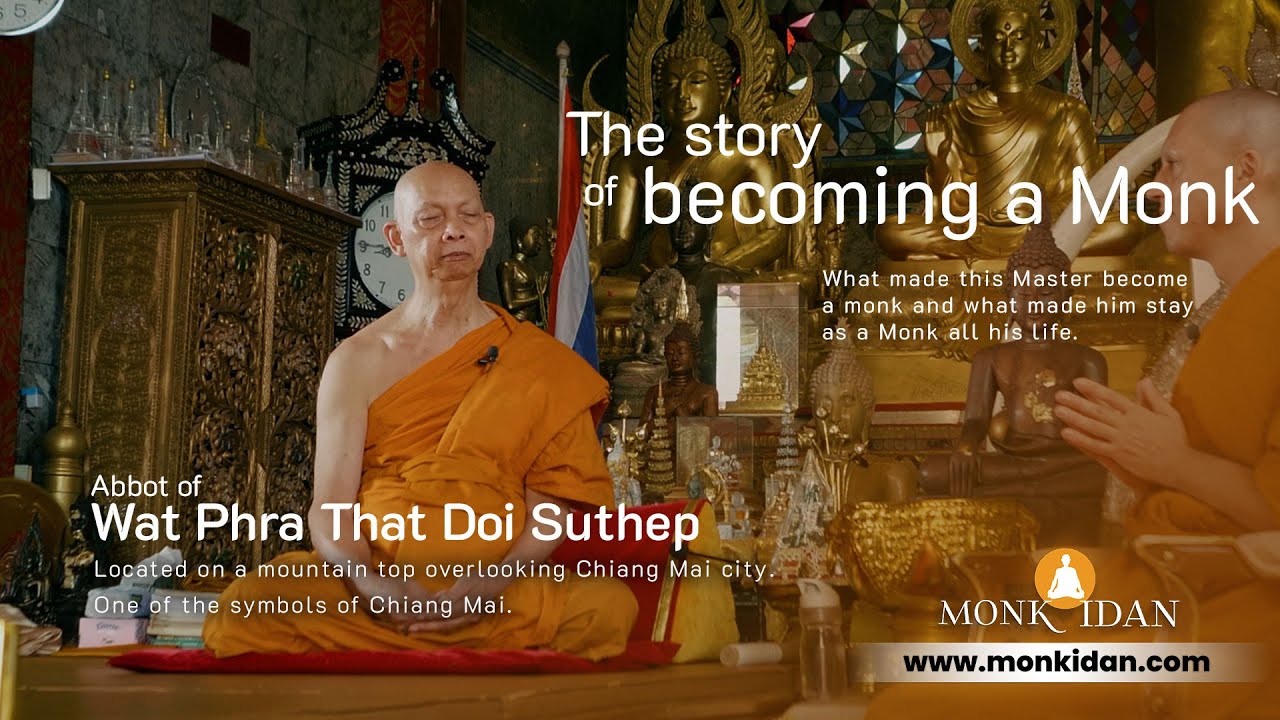
One of my favourite pieces is a biography of the abbot of Wat Phra That Doi Suthep, filmed as a natural conversation that gives full attention to the person in front of the camera. It came out more natural than a typical podcast format.
The first 15 minutes matter most
What decides whether an interview works is not the camera but the opening stretch that lets them forget it is there. So I do not start with the most important question; I start with easy ones, so they get used to the room, the lights and me, and move to the main points once they have relaxed.
Even if little of this ends up in the final cut, allow time for it. If their time is genuinely limited, 30–40 minutes is enough for a 2–3 minute clip.
What I bring
- Question themes sent in advance — prompts to recall stories, not lines to learn.
- Lighting and 2–3 cameras — hesitations can be cut without jump cuts.
- Wireless microphones for up to four people speaking at once — clear sound even in rooms that are not perfectly quiet.
- I ask the questions myself — keeping a rhythm that edits well, so your team does not need to sit in as interviewers.
What the company should prepare
- Three to five points you want covered, and who the clip is for.
- A quiet room where noisy air-conditioning can be turned off during takes, with space for lights.
- Time in their diary, including a warm-up before the real interview.
- Comfortable clothes that feel like them; avoid fine stripes, which often shimmer on screen.
- Names, titles and correct spellings for on-screen captions.
If they would rather not appear at all
Not every video needs an executive speaking to camera. If they prefer not to, narration over real footage of the work is quicker to shoot and costs less. Or let the people who do the work tell it — a line supervisor, an engineer, a customer who uses the product — who can be more convincing than the executive.
Work of this kind I have done includes employee interviews for an organisation, a customer testimonial for Qashier, and three-camera lit talking-head videos for an educational channel.
One interview, many uses
A single interview session usually yields more than one clip can use. With the questions planned well, one shoot can give you the main film for your website or a seminar, short vertical clips — one point each — for LinkedIn or TikTok, and strong lines to use as quotes or post graphics.
Tell me at the briefing where you want to use it, and I will plan the questions and framing so it can be cut both horizontal and vertical, without taking more of the executive's time.
Several interviewees — how many days?
If everyone is in the same place and free on the same day, it can be done in one day. Different places or days are priced and scheduled by shooting day. Tell me how many people, where, and what format you want, and I will send question themes and an initial price first.